this week in security — august 9 2026 edition
THIS WEEK, TL;DR
The world's hackers show off their top research, hacks, and findings at Black Hat, Def Con, and BSides Las Vegas
this week in security: Hackers from around the world descended on Las Vegas for the big three security cons of the year, aka hacker summercamp, which wrapped up Sunday. Plenty of folks couldn't make it, myself included. Thankfully, much of the best bits of the week were live streamed, and so I've wrapped up all the top talks, hacks, and research from the shows. Plus more: Wired ($) reported on a security researcher who hacked North Korean spies; a bunch of Chinese-made Zbtlink routers have backdoors (whoops); and find out what researchers discovered after scanning the Polish government web. We also, finally, got more details on that OpenAI hack of Hugging Face. Meanwhile, SecurityWeek has some vendor announcements if that's your thing, and HelpNetSecurity has photo galleries if you weren't there. Also: Our favorite security bug bulletin board Bugtraq is back (huzzah!). And, congrats to @malwarejake for winning the EFF charity poker this year.
More: RedmondMag | Reuters ($) | TechCrunch ($) | Cybercrime Magazine | Dark Reading | The Register | Cyberscoop | @eric_wallace_ | @biascilab | @dcuthbert | @yaelwrites
Well, great. More U.S. states are reporting cyberattacks on their water systems
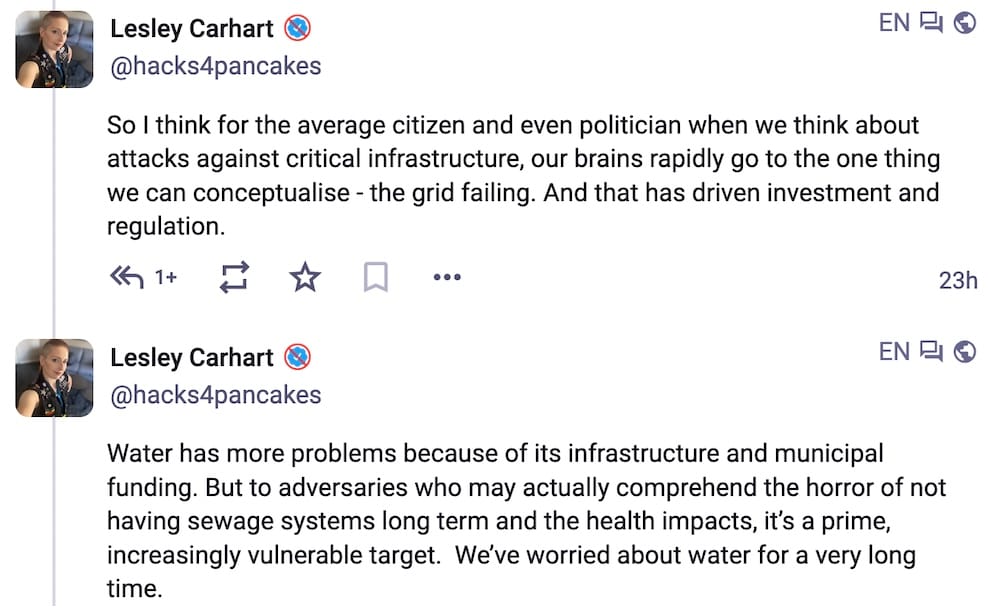
ABC News: At least 12 states, including Michigan, Minnesota, and now Georgia, are experiencing cyberattacks on their water providers. There have been no water safety alerts yet, but clearly these attacks are now spreading across the country far faster than the FBI can keep up. CISA is urging water facilities to pull their internet-facing equipment offline, with the agency's top bod telling @ddimolfetta on the sidelines of Black Hat that CISA is "still finding water system controls exposed to the internet with no password or only default credentials." Forescout has found literally thousands of water control systems exposed to the web. (Also from Def Con: the ex-NSA chief Paul Nakasone said water control systems don't belong on the internet. I mean, at least certainly not now, anyway.) Cyber policy wonk @ericgeller dives into how hackers and security professionals around the U.S. are volunteering their time to help secure their local water providers. Always listen to @hacks4pancakes on matters of critical infrastructure, please.
More: The Register | Vox | The New York Times ($)
Hedge funds and private equity targeted in recent social engineering attacks
Reuters ($): The hackers are coming after Big Money™, aka the major money managers at hedge funds and private equity firms. Both Reuters ($) and Bloomberg ($) reported that one big financial firm, Point72 Asset Management, was "attacked" (but no client data taken, they said), while Millennium Management, Two Sigma Investments, Citadel, and several private equity firms, were also targeted by social engineering attacks. Google said it's linked much of this activity to UNC6671, a group of a bunch of extortion brands under the same-ish umbrella, with the goal of stealing “valuable intellectual property, software source code, or sensitive VIP client data.” By targeting firms involved in mergers and acquisitions, the hackers may be aiming to "target high-value corporate and confidential data to maximize leverage extortion demands."
More: Google | TechCrunch ($) | Bloomberg TV
Hackers drain over $100 million in crypto by predicting passphrases for an offline hardware wallet
Tilo Mitra: Wild story here about how hackers pulled off a massive heist of over $100 million in crypto by predicting the passphrases, or seed phrases, that protected their cryptocurrency. Coinkite makes the Coldcard hardware wallet, which is offline so that it can't be hacked. This wallet doesn't store the crypto, but rather the passphrase used to control the crypto. But hackers figured out the way that Coldcard wallets generate their seed phrases, allowing the hackers to steal the crypto directly off the blockchain. Mitra does a great job of explaining this hack in detail; while researchers at Block have some real nitty-gritty detail. One victim said on X: "I never shared my seed phrase with anybody. My devices never touched the internet. Everything was kept in multiple safes and safety deposit boxes. None of it mattered." North Korea might be the obvious suspect; after all it loves stealing all that yummy crypto for its not-so-secret nuclear weapons program. But TRM Labs says, actually, the heist doesn't seem to match the regime's typical pattern.
More: Coinkite | Fortune ($) | TechCrunch ($) | Bloomberg ($) | Coindesk
~ ~
~this week in security~ is my weekly cybersecurity newsletter and blog supported by readers like you. Please consider signing up for a paid subscription starting at $10/month for access to exclusive articles, analysis, and more.
Or, you can submit a one-time tip or gift a paid subscription to show your support!
Recent blogs include: When AI chatbots and LLMs get legal, check your privilege | Most fitness wearables lack end-to-end encryption and don't disclose government data demands | U.S. judge denied feds a month-long warrant to snoop on the phones of thousands of Ohio residents | Online advertising giant Adform was hacked, proving once again why ad blockers are necessary | A beginner's guide to analyzing the network traffic of apps and websites
~ ~
THE STUFF YOU MIGHT'VE MISSED
More AI models escaped their sandboxes. Who's legally to blame? It's complicated
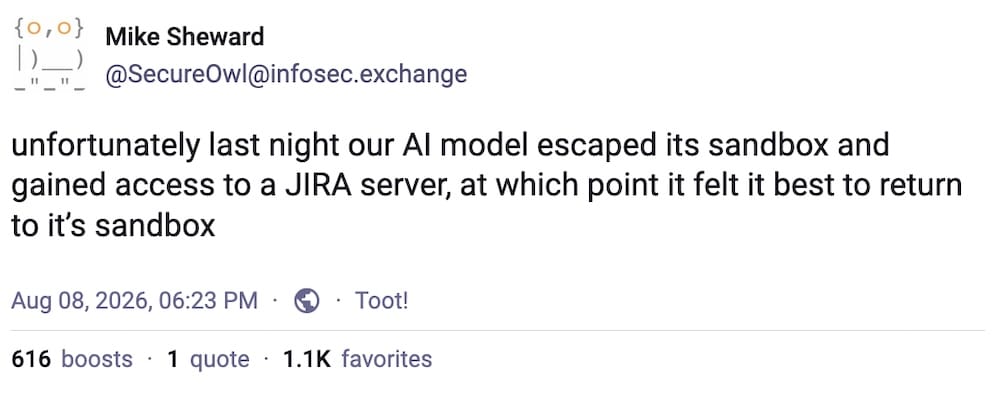
TechCrunch ($): A bunch more organizations with frontier AI models have 'fessed up to sandbox escape shituations, similar to the OpenAI-Hugging Face incident. Chinese model maker Kimi escaped its sandbox because the humans hadn't properly set it up, but the model didn't actually hack anything. The U.K.'s AI Security Institute said its cyber-tests went awry when some of its models tried to plant malware into an open source project by launching a social engineering attack against the project maintainer. And, Meta, just desperate for attention, also said it had an incident too. So… who is ultimately responsible for these incidents? @lorenzofb and I dig into the potential legal liability that Anthropic, OpenAI, and others might face after their hacks (disclosure alert!). You're probably going to hate the answer.
N-able says attackers are abusing its N-central software to raid customer networks
The Register: N-able says attackers are exploiting a zero-day in its N-central remote access software to gain unauthenticated access (ie. no passwords needed) to a customer's admin panel. The hackers are using the platform's Take Control feature to connect to systems inside a customer's environments and steal data. Feds have been told to patch ASAP. Huntress had already disclosed all this because hot-damn they're worth their salt.
Samsung bans residential proxy networks after promoting some as 'editor's choice'
Mnemonic: Security researcher Harrison Sand rooted a Samsung TV and found its app store to be a hot mess of apps packed with residential proxy network code. Resproxies allow outsiders access to your internet connection (often for crime). Some of these apps Samsung promoted as its own "editor's choice." The company told me (disclosure alert!) it's banning the apps, following in the footsteps of earlier findings by Brian Krebs.

Dozens of Windchill customers had data stolen by the Clop extortion racket
@mle: There are now around 42 alleged victims linked to Clop's latest hacking spree targeting customers of PTC's Windchill and FlexPLM product lifecycle management software. The leaked data differs from the usual array of personal information, with the hackers instead taking CAD files, databases, backups, and other engineering schematics. Here's some earlier background from Censys.
Windows malware can steal passkeys from Google's Password Manager
Bleeping Computer: Palo Alto Networks has published new research showing that it's possible for malware, which had already been installed on Windows devices, to abuse access to Google Password Manager and steal a user's synced passkeys. The novel attacks don't abuse the cryptographic protections of passkeys, but rather how Google Password Manager stores them. The researchers say it's possible to achieve full account takeover this way.
An unsecured police dashboard in China shows how authorities keep track of people
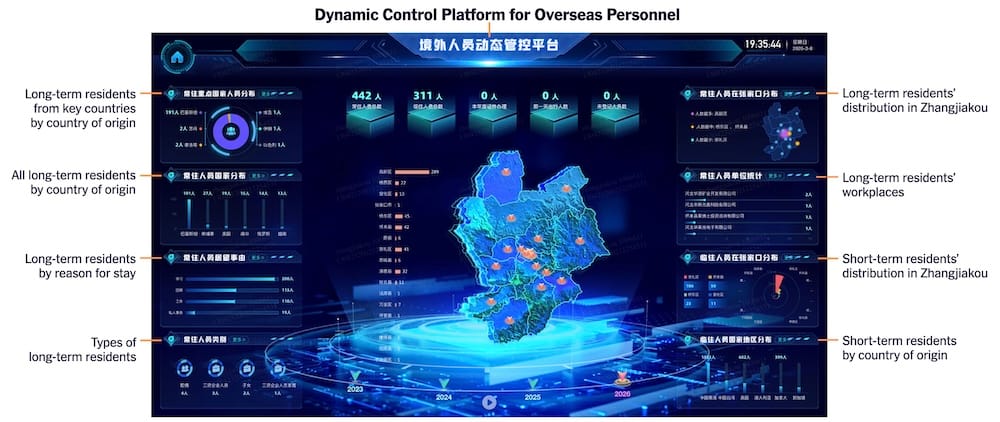
The New York Times ($): An unsecured police dashboard left exposed to the web offers a rare glimpse into how Chinese authorities use technology to surveil people. Security researcher Marc Hofer found the exposed panel — and his own data.
FBI agent steals ~$900k in crypto, but bottles it and confesses
CNN: The feds caught an FBI agent who allegedly stole over $900,000 in crypto from an overseas suspect, in part by admitting it, both to FBI agents who turned up to his house, and then earlier to ChatGPT. The hapless agent allegedly asked the chatbot: "If you had a bucket of money (around $1 million) and you wanted to leave the USA and become a resident or citizen of an EU country, what would you do?" And no, it's unlikely that the arrested fed can claim these chatbot logs were covered under attorney-client privilege.
AI notetaker spilling its users' video calls, thanks to leaky database
BobDaHacker: Popular meeting assistant tl;dv, which automatically joins and transcribes video calls, is spilling the details of over 181,000 meeting recordings from its publicly exposed Google Firebase database. These include from government departments, universities, and tons of private companies. Her blog has all the deets. Dark Reading reached out but didn't hear back. (Update: the company fixed it.)
Russian spies targeting people by hijacking Wi-Fi at hotels and conferences
Microsoft: Hackers working for Russia's foreign intelligence agency (aka APT29) are tampering with hotel Wi-Fi networks. The hackers are redirecting victims to ClickFix hacks to deliver malware, and even Android apps delivered to mobile users. ReliaQuest also has research on this.
~ ~
OTHER NEWSY NUGGETS
100k bobbies' birthdays breached: U.K. authorities are investigating a data breach involving the names and personal info of more than 100,000 officers, including police, and staff with the Home Office and National Crime Agency. A relatively new extortion group stole the data and is threatening to release it unless the U.K. pays a ransom. The Times ($) verified some of the leaked data as accurate. The legendary DataBreaches.net went and asked how the hackers did it. (via Bleeping Computer)
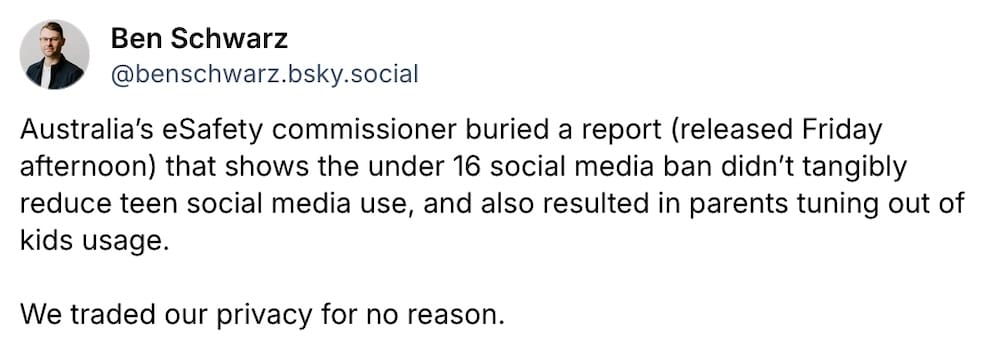
Aussie's age verification laws are a bust: Australia's eSafety commissioner found that the country's under-16 social media ban hasn't substantially reduced kids' social media usage. Age verifications laws are popping up around the world, including Australia, and are seemingly having little effect, except for the huge invasions of privacy. (via The Conversation, Outlook)
Big Brother on steroids: John Oliver spent last Sunday's Last Week Tonight ripping down the police surveillance state in its current form and where it's going. Oliver explains how cameras, microphones and license plate readers are fueling tracking, snooping, and police abuses who can't keep their grubby hands out of their department's databases for stalking people. If you needed a refresher on just how bad the situation is and what you can do about it (and there are plenty; governments forget that they are nowhere near as powerful as their people!), this half-hour episode will get you up to speed. (via The Guardian, WJAR, @lastweektonight)
Apple demands U.K. shut the backdoor: The fruit-themed device maker is challenging the U.K.'s not-so-secret legal demand to make an iCloud backdoor for British authorities. An earlier effort saw London demand access to any customers' data anywhere in the world. Now the U.K. is pulling the same shtick, just excluding American users, so as to not invoke the wrath of Washington like it did last time. (via Financial Times ($), BBC News)
Meanwhile… Apple hasn't fixed its own privacy leak: Not exactly a great look though for Apple, which can't seem to plug its own privacy issues. Researchers disclosed this week that Apple Private Relay isn't always so private, and could be tricked into exposing a person's real IP address, defeating the point of the thing altogether. Apple's looking into it — yeah, at the speed of slow. (via 404 Media ($), Mysk)
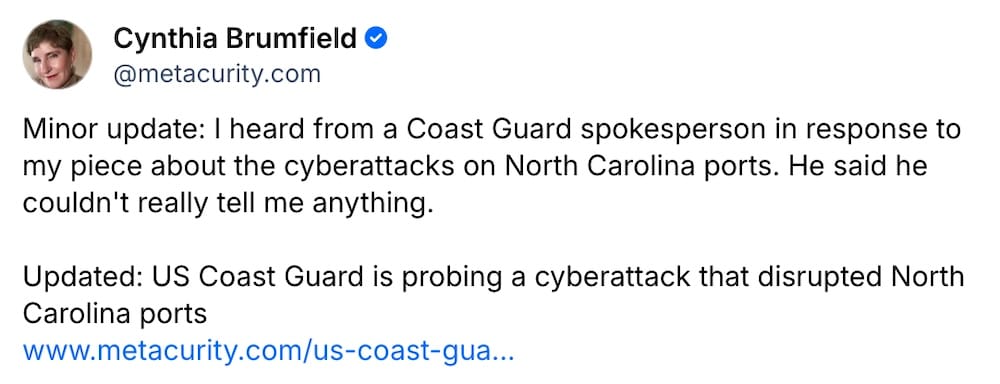
North Carolina ports hit by hackers: The U.S. Coast Guard and other state cyber authorities are investigating a cyberattack late Tuesday on three of the state's ports, which caused an outage and disruption to operations. (via WCET, @metacurity)
Charities curse cyber'd CRM: Several U.K. charities have confirmed data thefts related to a breach at BeaconCRM. Hackers are likely to have stolen a substantial amount of data, if not the lot. Expect this one to blow up over the next few days or so as more victims report breaches. You might not have found Beacon's incident page because the company hid the page from search using "noindex" code. (via The Register, DataBreachToday, ITV)
~ ~
THE HAPPY CORNER
Holy heck… that was a busy one. Let's take a minute to unwind, relax, and chill out in… the happy corner. Welcome in! Aaaaaand breathe.

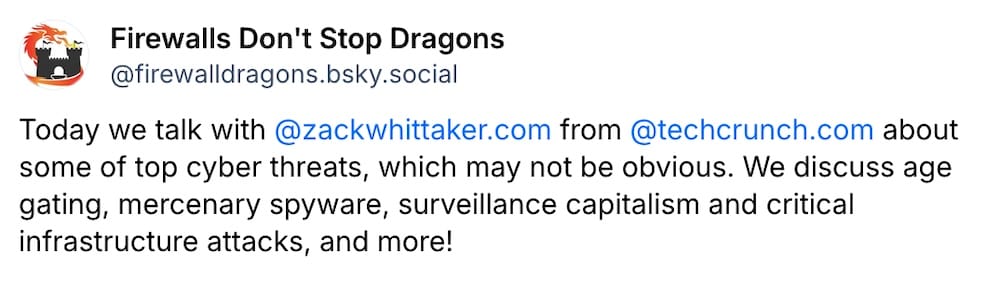
I was thrilled to join the esteemed @FirewallDragons' podcast to chat about all the things I'm thinking about in the world of cyber, from the biggest threats on the internet, how you can defeat some of the worst surveillance of today, my reporter's point-of-view on security journalism, and yes, even some spicy views about AI (groans). Thanks so much to Carey Parker for a really fun chat. Grab some coffee and pop your headphones in for this hour-long chat. (Also, this might be how some of you find out that I have a British accent. Or at least whatever it is after a decade-plus stateside. Ameriglish? Britisherican?)
Congrats to the awesome folks at @ifin, which became a non-profit this week. If you haven't checked them out already, you should; it's a great community of security folks who share, analyze, and discuss cyberattacks and threat intelligence.
You know what's a really big help for security researchers? Letting them know how to reach you, but all too often companies don't publicly say how to contact them about security issues. Having something like a security.txt file is a great way to direct security researchers to your internal bug-squashing team… or(!), you can use DNS records, which is also easy to do. Here's how to get started.
Mark your calendars! On August 12, I'll be hosting a Reddit AMA with the incredible security researcher @runasand to discuss the recent case of an American who was charged with a felony for allegedly providing U.S. border authorities with a "duress" password that wiped his phone during an airport interrogation. We're answering questions about the case, what it means, and other practical security advice for folks who are planning to cross borders. Join us!
And let's end on this perfect closing thought:
Got good news to share? Get in touch! this@weekinsecurity.com.
~ ~
CYBER CATS & FRIENDS
This week's cyber cat is Toby, one of my two handsome cat sons, who can be seen here at his peak last week as "king of the cat tree." Unusually for him, he woke up this morning and decided he hated the world a little more than usual, and so I filed this newsletter a touch later to get him seen at the local vets. He's fine, thankfully (though the scratches on my arm getting him into his carrier might say otherwise). At least he got pampered and swooned over by all of the techs who absolutely adored him. (And thanks for your patience with my delay today.)

🐈 Send in your cyber cats! 🐈⬛ Got a cat or a non-feline friend? Send me an email with their photo and name and they will be featured in a later newsletter!
~ ~
SUGGESTION BOX
...What a week, pheeeew! I won't keep you another moment, that was incredibly busy. Thank you so much for reading, subscribing, and supporting this newsletter. I really appreciate you.
If you liked this newsletter, please share it on your social media, or feel free to forward along. And, as always, if you have anything to share for next week's edition, I'd be thrilled to hear from you.
Catch you next Sunday, and enjoy your week.
Until then,
@zackwhittaker