Vigilantism comes for Flock

A growing campaign of vigilantism and vandalism against the billion-dollar startup Flock is sweeping across the United States.
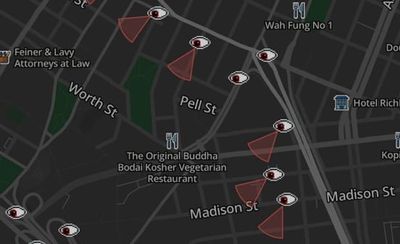
Flock makes and sells surveillance cameras that monitor and log the license plates of cars, and relies on AI to track people as they pass by. The company has at least 135,000 cameras in the U.S., allowing police officers from all over the country to tap into Flock's massive nationwide camera network for investigations, including cameras outside their jurisdictions. Flock cameras are also sold to private businesses and residential organizations, like homeowner associations, extending the network of cameras that cops can access into residential spaces.
But public opinion is shifting firmly against license plate trackers like Flock. A recent poll shows that more Americans oppose law enforcement's use of license plate camera trackers than support them, a reversal from a year ago when the majority of Americans said they were in favor of the technology.
People are cutting down Flock cameras placed on roadside poles at a near-daily rate. Some cameras have been smashed, spray-painted, and shot at, while some people are relying on novel methods of destroying Flock cameras, like spraying foam-expanding sealant into them. One incredibly stubborn man sat in front of a Flock camera with a 12-foot-pole to lawfully block it out of sheer hatred for the thing. And, TikTok is awash with guides on how to identify Flock cameras, while some are documenting their efforts showing how to covertly disable them.
Some police departments said they would go after the vandals, with limited success. In at least one case, a grand jury of local residents declined to bring charges against a person in their community who was accused of destroying a Flock camera. Other police departments are seeing the movement as a clear signal from their residents to remove the cameras. The LAPD, the third-largest U.S. police department, allowed its contract with Flock to expire after saying it had "serious concerns" with privacy and civil liberties regarding its use of the Flock system.
These incidents of vandalism are reaching mainstream attention, with reports of attacks on Flock cameras now in over 50 regions in the United States, yet this is a drop in the ocean of Flock's massive network of cameras. But the attacks are representative of a growing public sentiment over intrusive tracking, as more cities and communities reject the cameras — sometimes with force.
Guns drawn, wrongful arrests, and police misuse
It's difficult to pinpoint the exact reason why Flock has become the target of recent vandalism, but signs point to a mix of factors happening at once, and likely overlapping with a broader disdain for AI, data centers, and Silicon Valley at large.
Flock has taken on millions of dollars in venture funding and is currently valued at more than $8 billion. The company has used a mix of aggressive marketing and lobbying, coupled with a lack of regulation to expand rapidly into local communities. But while Flock is far from the only surveillance enabler out there, Flock has become the poster-child for the increasing encroachment of surveillance into everyday life. It likely doesn't help that Flock cameras are easy to spot, thanks to their custom branding and the highly distinctive solar panels that power them.
~this week in security~ is my weekly cybersecurity newsletter and blog supported by readers like you. Please consider signing up for a paid subscription starting at $10/month for access to exclusive articles, analysis, and more.
Or, you can submit a one-time tip or gift a paid subscription to show your support!
Recent blogs include: How residential proxy networks are hiding hackers in your home | The top highlights from Black Hat, Def Con, and BSides Las Vegas 2026 | When AI chatbots and LLMs get legal, check your privilege | Most fitness wearables lack end-to-end encryption and don't disclose government data demands | U.S. judge denied feds a month-long warrant to snoop on the phones of thousands of Ohio residents | Online ads giant Adform was hacked, proving once again why ad blockers are necessary | A beginner's guide to analyzing the network traffic of apps and websites
One reason why Flock has received so much attention is that its cameras have been beset with problems. Flock cameras have repeatedly misidentified license plates, resulting in police wrongly pulling over drivers and arresting them — in some cases with guns drawn on entirely innocent people. Flock cameras have also had security issues, including being publicly accessible from the internet. This allowed anyone to access a Flock camera's web dashboard, even though these systems are largely restricted for law enforcement use.
The scale of Flock's surveillance is huge, granting police the ability to track people nationwide from one side of the country to another. Police can search Flock's database for plates outside of their town or city borders, while also sharing their cameras with other agencies and federal authorities. In doing so, local police departments can access a surveillance system that captures the movements of a broad swath of America.
Perhaps the main reason for drawing public ire is that Flock has been associated with countless abuses by police themselves. There have been at least a hundred known and documented police officers to date caught abusing access to these systems, oftentimes to stalk their ex-partners among others. While multiple cops have been arrested or fired, others have been allowed to resign with little in terms of lasting consequence. And, federal agents were caught accessing Flock's databases to search for immigration violations, at a time when ICE agents continue to openly abduct people in the streets.
All of this is happening against a backdrop of greater inequality in the U.S. and rising bipartisan dissatisfaction with nearly everything happening across the globe today, much of it sparked or worsened by the policies of the current U.S. government.
Surveillance isn't new. Why the anger now?
I've covered surveillance and its abuses for more than a decade, including license plate tracking before it was in the national spotlight. Yet, nothing else in my career seems to match this palpable real-world anger against Flock. It's a rare example of a broad collective rebuke against a mass surveillance technology.
The biggest surveillance scandal in my living memory and reporting years was the Edward Snowden leaks of classified documents that revealed the National Security Agency's mass global spying programs. The NSA leaks sparked huge debate and the tech industry moved in response to encrypt all the things. But much of the reaction from the American public boiled down to "well, of course they're spying on us," and "the government's not looking at my data," even if it was collecting enormous amounts of it and still very much able to. People seemed to feel that they were a figurative needle in a haystack of no real interest to the authorities.
The scandal with Flock is much closer to home and I suspect a lot more tangible for folks to see the harms up close. We're seeing abuses happen at the local level, not by some nebulous or figureless government entity. We're talking about ostensibly trusted people who are abusing their positions of authority to spy on other people in their own communities.
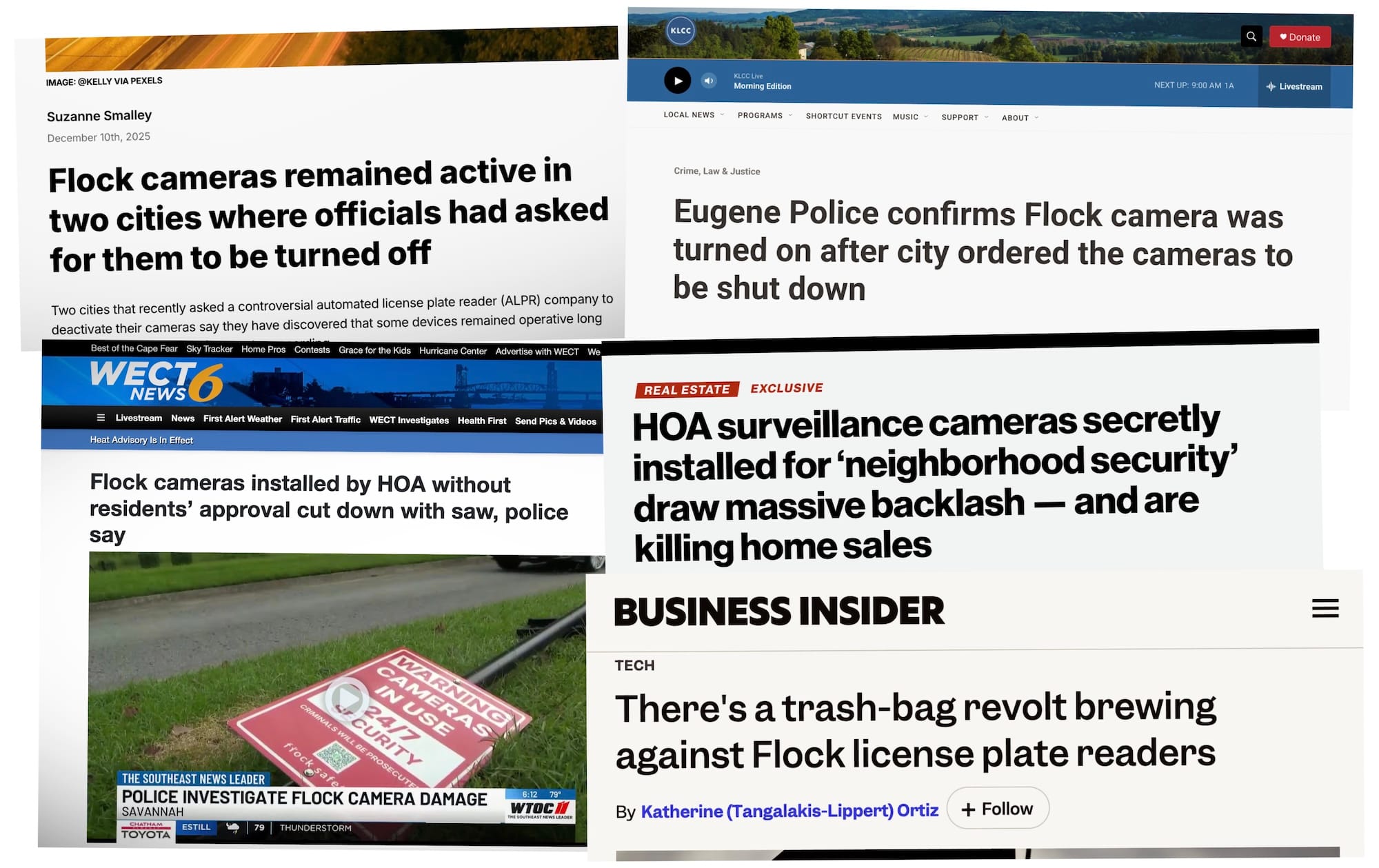
Homeowners associations are also facing the heat, from vandalism to lawsuits, as the existence of Flock cameras in private communities has been met with similar resistance. The existence of Flock cameras have allegedly killed house sales, and sparked fears of voyeurism when one Flock camera was pointed close to a swimming pool.
Another frustration factor is that when people protest and lawmakers take action, Flock keeps returning like an unwanted party guest. People are doing things right — attending public meetings, complaining to their elected representatives, and peacefully protesting — and it doesn't always make an immediate difference. Some of those officials receive bad information, or act against what the people demand, and plow ahead anyway. While they may face the voters at the polls, that future date in the calendar does nothing to solve the very real surveillance harms of today.
When officials renege and side with voters to cancel or scrap their contracts with the company, Flock has moved to reinstall new cameras without permission. Towns found that their Flock cameras were switched back on and re-enabled, while others sent letters to Flock ordering the company to stop reinstalling cameras without their authorization. And when nothing happened, some communities taped garbage bags over the cameras to block them from working.
What plays out is an unwinnable loop where the cycle sometimes breaks, albeit only briefly, when people feel that they have no other option but to take matters into their own hands. A peaceful protest is in itself a tacit threat that the next protest might not be so peaceful.
Flock is not playing by the rules because it argues that the rules, such as local legislation, do not yet exist to enforce or regulate companies like Flock. It's a circular reasoning that allows companies to get away with new kinds of surveillance because the activity falls within a gray legal space not covered by any specific law. Laws can be incredibly slow to update. This gives companies enough runway to make piecemeal voluntary changes in the face of public pressure that ostensibly address some of their major critics' complaints without having to be legally bound by them.
Fleeing from Flock, but not the surveillance
More towns and cities are scrapping their Flock contracts and the cameras themselves, following sustained public pressure from their residents. The recent spike in backlash prompted Flock to take some of those aforementioned voluntary steps to self-regulate by adding new guardrails, an admission that the company had previously gotten things wrong.
Flock said it will start auditing its systems better and flag suspicious searches by law enforcement with the aim to curb abuse going forwards. The company hasn't said how some of these audit features will work, and civil liberties advocates have called them "window dressing."
But the pushback isn't slowing; it's bipartisan. Lawmakers in Congress are investigating Flock. Meanwhile, Republican strongholds like Florida and Texas have blocked Flock from operating in their states, dealing one of the broadest blows to the company to date. Pennsylvania is likely next on the list of states moving to ban Flock.
For its part, Flock has made no effort to back down from its broader nationwide rollout, while still touting new customer success stories on its website. Flock's founder and chief executive Garrett Langley recently said there should be a "compromise" between safety and privacy, drawing fresh ire from critics, suggesting no slowdown in the company's plans to expand. Flock did not respond to my request for comment.
These acts of vandalism speak to a deep anger that people feel towards government surveillance and privacy intrusions, with license plate readers as the recent catalyst. The next immediate battle for residents is trying to prevent their community leaders from moving instead to the next nearest alternative to Flock.
One of the big rivals is surveillance camera maker Axon, the same company that makes police bodycams and Tasers, which has faced less scrutiny for its license plate readers and surveillance system than Flock. 404 Media and Military.com report that some towns are ditching Flock and moving their contracts to Axon, which these towns say is better for civil liberties as Axon doesn't have a nationwide search system like Flock. Others are moving to surveillance alternatives like Vigilant, Verkada, Motorola Solutions, and more. Critics argue that by moving from Flock to a rival company, the surveillance continues on but just under a different vendor.
Destroying things sets a slippery precedent. But it's clear that this pattern of destruction against Flock cameras is a warning shot towards Big Tech that there are limits to mass surveillance that people are willing to accept.
Thank you so much for reading and subscribing to ~this week in security~! I hope you enjoyed and found this article helpful. If you like it, please share a link on your social media! Please reach out with any feedback, questions, or comments about this article: this@weekinsecurity.com.